Empowering Active Lifestyles
For Singaporeans
Project Type
UX Research
Team of 3
Timeline
2024
Role
Team Lead
Design System & Prototyping
Key Skills
Planning and Deploying Design Sprints
Variables and Conditioning Prototyping
Unmoderated Usability Testing

Project Overview
ActiveSG is an all-encompassing and inclusive national movement for mass participation, brought to you by Sport Singapore in 2014. The timeline for this project is approximately 15 weeks (based on academic timeline).
Met the objective:
✅ To plan and lead the project based on academic timeline of approx. 15 weeks using 5 planes content strategy framework ensure deliverables met user and business objectives, doubling up as interaction designer to deliver variables and conditioning prototyping.
🎉 To achieve average 80% feature adoption rate and 83.3% direct success from usability testing results.
Just to be clear, I am not linked with ActiveSg in any way and the opinions expressed in this case study was created to improve my learning experience and to challenge myself to rework it for a specific purpose. In terms of app referencing iOS Version: 2.58, Android Version: 2.51.
Strategy Plane
Introduction
ActiveSG is an all-encompassing and inclusive national movement for mass participation, brought to you by Sport Singapore in 2014. Conceptualised under Singapore's Vision 2030 to extend the reach of sports programming and encourage a healthy lifestyle for all residents. The product objectives defined is to empower users to prioritise family well-being by facilitating the planning and execution of at least one shared physical activity per week or month.
Design process

Mapped to these key phases from the Double Diamond Framework
Discovery & Define
Secondary research
For this process, I've scoped the secondary research to four key areas:
1. Data visualisation: Accessibility trends, User JTBD and Goals
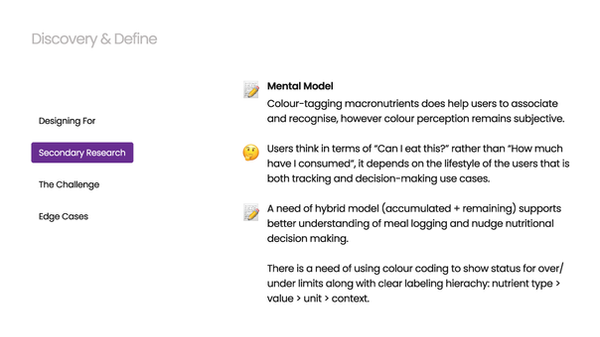
2. User's Mental Model
3. Opportunities to overcome the challenges- public's perception of nutritional literacy, meal logging habits- to define the existing adoption rate and a way to define the success from the enhancement
4. Edge cases
For the secondary research objective, it is used to define the prototype that will be used to validate with member's of the public through usability testing.


Problem statement
How might we...
educate Singapore residents of diverse ages and health profiles to build confidence and relevance in nutrition tracking through daily planning, logging and evaluating food logged item for better nutritional decision-making?
From this, it is not only used to define the ideation, but also to define the scope of usability testing:
1. The perception of confidence
2. The user tasks required to achieve
3. To validate one of the organisational behavioural goal: to educate Singapore residents with better nutritional decision-making
Uncovering Singapore resident's
journey experience

For this process, I've scoped the secondary research to four key areas:
1. Data visualisation: Accessibility trends, User JTBD and Goals
2. User's Mental Model
3. Opportunities to overcome the challenges- public's perception of nutritional literacy, meal logging habits- to define the existing adoption rate and a way to define the success from the enhancement
4. Edge cases
For the secondary research objective, it is used to define the prototype that will be used to validate with member's of the public through usability testing.
Surface Plane
Usability Testing
In terms of Testing Objectives, it is used for Validation of Concept from general consensus on how they feel about it and Usability Testing on the Purchase Passes since the workflow got major changes.
In terms of the Usability Testing, the metrics use to measure the success is the task completion rate and also to identify if there is any misclicked of buttons.

Further Considerations & Reflection
Workflow Considerations for the Project
To improve on the refund of passes due to wet weather occurrence
In terms of sharing of calendar access, to create and build on the flow and the security aspects
To improve on booking of programmes flow, ensuring every user can achieve their exercise objective
For this prototype, there are also sound feedback as part of enhancing the accessibility of the app, click here to view the live version.
Personal Reflection
I think in general it was a meaningful, being able to contribute back to Singapore given this a public service application. It is definitely one of my personal break through of leading a project and also prototyping using condition variables via Figma. Shout out to my team members Tristan Tan and Eric Ngian for making this project a success too :-)